
Free HSE tool · Inspections & Checklists
Occupational Hygiene Checklist
Occupational hygiene is the branch of HSE that measures — noise in dBA, the dust in mg/m3, the fume in ppm, the vibration in m/s2 — because the chemical and physical agents that do their damage slowly do not announce themselves. The OH survey is the structured walk with the instrument: what is the agent, where, who is exposed, for how long, what is the measured value, what is the limit, and what is the action.
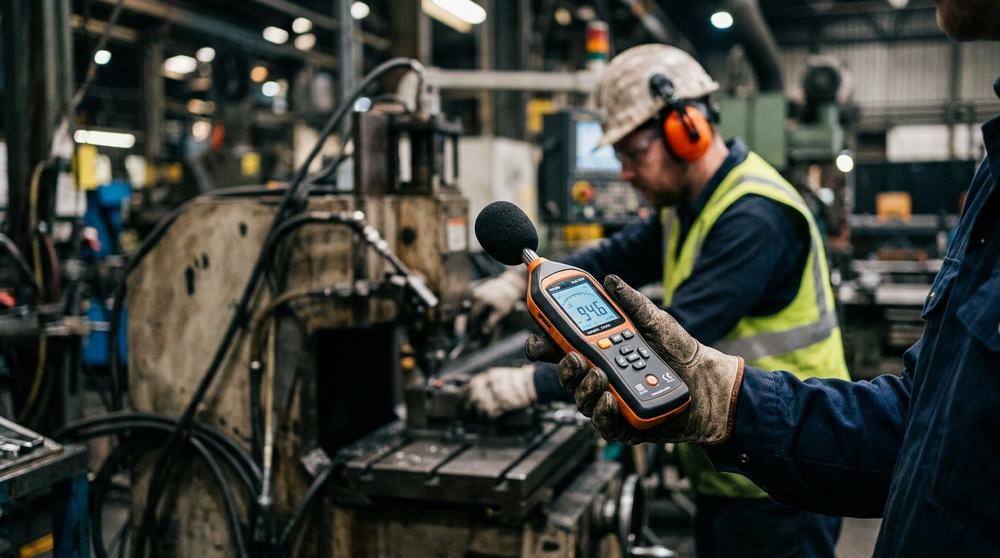
Free Occupational Hygiene Survey Checklist
One row per agent — enter the measured value and the tool checks it against the limit and writes the status and the action.
| Agent (limit auto-set) | Source / location | People exposed | Duration | Measured | Limit | Status | Action |
|---|
Limits (working reference): noise — 85 dBA L_Aeq,8h (UK upper action value; OSHA 90) · respirable silica — 0.1 mg/m3 (UK control band) · welding fume (in) — 4 mg/m3 · CO — 30 ppm · H2S — 10 ppm (UK 5 good practice) · hand-arm vibration — 5.0 m/s2 (action 2.5) · the stricter value governs.
Work the survey below: add a row per agent, enter the measured value, and the tool compares it to the limit and writes the status — below, at, or above. The limits table below is the working reference: the UK values and action levels alongside the OSHA PELs and action levels, so the survey speaks both languages.
How to use the tool
- Identify the agents — the noise, the dusts (silica first), the fumes, the vapours, the vibration, the temperature
- For each, set the source, the location, the people exposed and the duration — the exposure, not just the agent
- Measure — the instrument reading: the dBA TWA, the mg/m3, the ppm, the m/s2 — and enter it in the row
- Compare to the limit — the tool sets the status against the limit shown
- Action — the control for the above-limit row, the monitoring plan for the near-limit row, and the health surveillance where the exposure is ongoing
Worked example
A grinding workshop OH survey. Noise — measured 89 dBA TWA at the grinder, the 85 action level exceeded: hearing conservation in place, the extract fan on the grinder brings the bay level to 84 on re-measure, the remaining exposure is within the limit with the rotation. Silica dust — the dry-grinding task: measured 0.4 mg/m3 respirable, against the UK control band of 0.1 — wet-grinding required, the dry task stops until it is wet or enclosed. Welding fume — 1.8 mg/m3 total, within the 4 mg/m3 limit, local exhaust on, the surveillance (the lung function and the blood) continues. Vibration — the angle grinder at 4.2 m/s2 daily against the 2.5 action value: rotation and the low-vibration tool, the hand-arm surveillance in place. Two actions, one surveillance plan, the survey printed and the re-measure dates set.
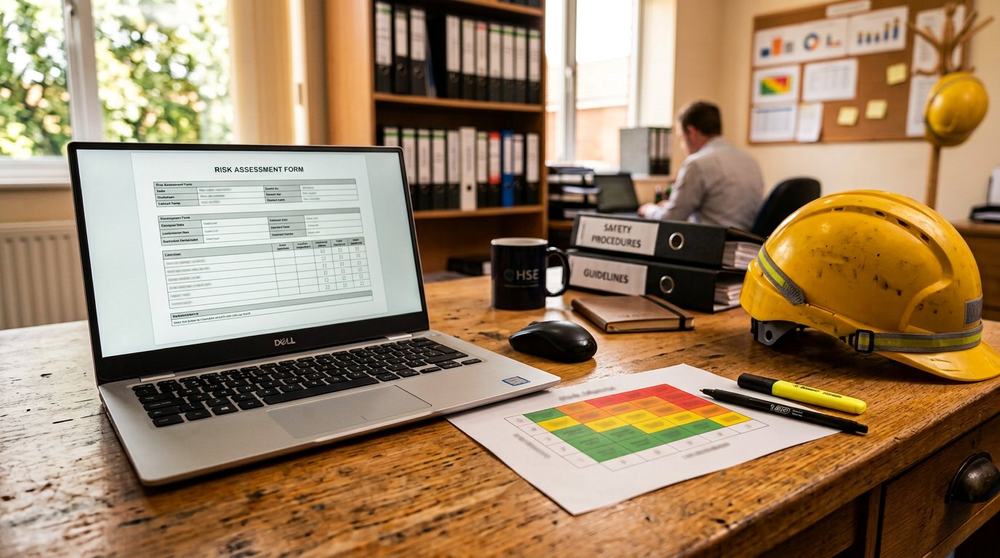
Standard & legal context
The UK Workplace Exposure Limits (WELs) under the COSHH and Control of Dust regulations set the measured limits, with the lower action levels (the 85 dBA for noise under the Control of Noise at Work Regulations 2005) as the early-warning line. The OSHA PELs and the action levels (the 90 dBA TWA with the 5 dBA exchange) are the US pair. The ACGIH TLVs are the professional reference the hygiene practitioner uses when the law is silent. The table below carries the working limits for the common agents — the survey compares the measurement to both, and the stricter governs.
Common mistakes
- Surveying the agent and not the exposure — the limit is on the exposure (the TWA, the time-weighted value), not on the instantaneous peak nobody can act on
- Measuring once and filing it — the survey is a baseline; the re-measure after the control is the proof the control worked
- Skipping the silica — respirable crystalline silica is the agent with the lowest limit and the longest latency, and the dry task is the one that exceeds it
- No health surveillance on the ongoing exposure — the measurement says the level; the surveillance says the effect, and the two together are the OH record
Need the sign-off, not just the tool?
The tool is the preparation; the sign-off is the professional. For the statutory assessments, the audits, the ISO 45001 implementation and the training that comes with them, ask Muhammad Umer — 8+ years across Iraq, KSA and Pakistan, and the programme runs through umer-hse.pro. One message gets the written scope.
Common questions
Occupational Hygiene Checklist — answered
What is an occupational hygiene survey?
The structured measurement of the chemical and physical agents at work — noise, dusts, fumes, vapours, vibration, temperature — against the people exposed and the limits, producing the exposure record, the action list and the surveillance plan.
What is the difference between an action level and a limit?
The limit (the WEL, the PEL) is the legal maximum; the action level is the lower line that triggers the programme — the monitoring, the surveillance, the control review — before the limit is reached. Both are in the table below.
What is the UK noise action level?
85 dBA as the 8-hour equivalent — the upper action level, where hearing conservation is required; 80 dBA is the lower, where the opportunity for control is identified. OSHAs is 90 dBA TWA with the 5 dBA exchange rate.
Who does the OH survey?
A competent occupational hygiene practitioner — the measurement needs the instrument, the method and the judgement. The HSE COSHH and noise guidance, the NEBOSH and IOSH OH units are the training; the employers duty is the arrangement, and the survey is the core of it.
Do I need a survey for a small workshop?
If there are the agents — the grinder, the welder, the solvent, the diesel — yes: the duty is on the exposure, not the headcount. The tool on this page is the structure; the measurement is the competent persons instrument work.
Can I print the OH survey?
Yes — the Print button produces the survey: the agent rows with the measured values, the limits and the status, the actions, the surveillance plan and the re-measure dates. It is the document the inspector and the clinician both work from.
Keep building
Related tools
Workplace Inspection Checklist
Free workplace safety inspection checklist: 30 items across fire, electrical, housekeeping, PPE, welfare and d
Risk AssessmentsCOSHH Assessment
Free COSHH risk assessment tool: assess the substance, the exposure routes, the hierarchy of controls, pre- an
Calculators & AssessmentsNoise Exposure Estimator
Free noise exposure calculator: enter the levels and the times, get the 8-hour TWA, the OSHA dose, and the act
THE HEALTH AND SAFETY is an education and knowledge network. The tools are free and open; the professional assessments and audits run through umer-hse.pro.
Safety disclaimer
These tools are practical guidance, built to the UK baseline with the US equivalents named on each page. They do not replace a competent person assessment for high-risk work, a statutory assessment, or the advice of your insurer. Where a document has legal force — the fire risk assessment, the COSHH register, the permit to work — the responsible person owns it. Use the tool as the preparation, and the competent person as the sign-off.