
Free HSE tool · Inspections & Checklists
Workplace Inspection Checklist
The workplace inspection is the HSE officers most frequent instrument — the structured walk that turns the site looks fine into a scored, dated, owned record. Done regularly, it catches the small thing before it becomes the incident report; done well, it is the evidence that the management system is actually managing.
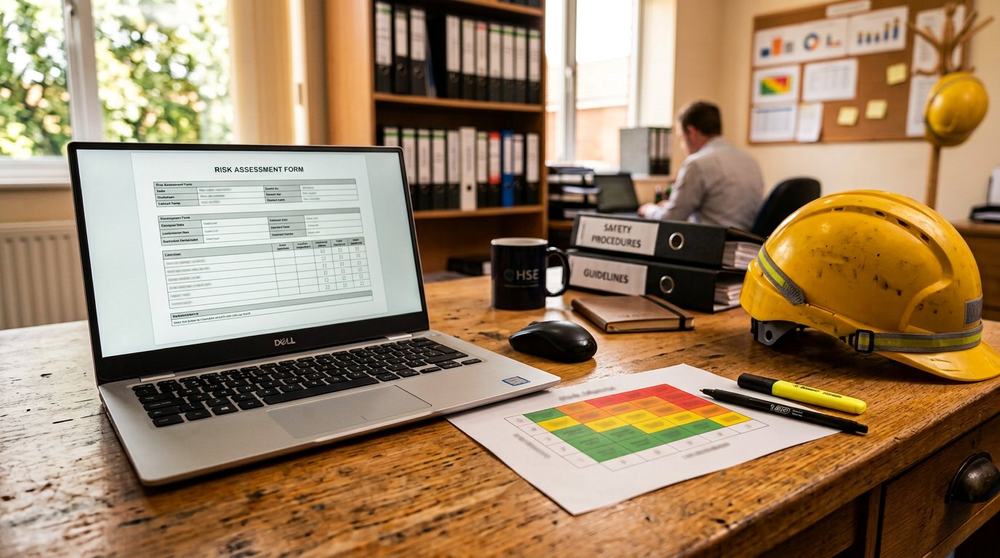
Free Workplace Safety Inspection Checklist
30 items across 7 areas — mark pass / fail / N/A, the score and verdict are automatic, then print the dated report.
Run the inspection below: every item is pass, fail or not-applicable, the tool scores the result and writes the verdict, the findings box carries the specifics, and the print button produces a dated inspection report with the action list. The checklist is built to UK inspection practice and works for any workplace with the N/A column.
How to use the tool
- Set the site, the date, the inspector and the area — the header of the report
- Work the checklist area by area — fire and exits, electrical, floors and housekeeping, PPE and first aid, equipment, welfare, documentation
- Mark each item pass, fail or N/A — a fail needs a finding: what, where, how bad
- Read the score — the tool calculates the percentage and the verdict (satisfactory, needs attention, urgent action)
- Print the report, assign owners and dates to every fail, and brief the area manager the same day
Worked example
A 30-item workshop inspection, 8:30–9:45: 24 pass, 4 fail, 2 N/A. The fails: one blocked fire exit (the racking — moved and re-marked the same day), a damaged extension lead in the welding bay (quarantined, replacement issued), the first-aid box past its expiry (new kit ordered, owner the supervisor), and a missing LOTO tag on the compressor (procedure re-briefed at the toolbox talk). Verdict: needs attention, 4 actions, all with owners and dates by end of shift. The next months inspection opens with the same four lines as the first section — were they closed? That callback is what makes the inspection programme a system instead of a form.

Standard & legal context
The inspection is the operational arm of the UK management-of-safety duties — MHSWR regulation 3 requires adequate arrangements, and the inspection is the standard evidence of them. IOSH and NEBOSH both teach the inspection as a core practitioner skill, and the HSEs own inspection practice of workplaces follows the same structure: plan, walk, score, record, follow up. In the US, the OSHA 300/301 recordkeeping and the site safety and health plans sit on the same inspection foundation. The checklist below is the UK general-industry pattern.
Common mistakes
- Inspecting from the office list without walking the route — the checklist is a memory aid for the walk, not a replacement for it
- Passing acceptable — a pass is a pass; anything that needs watching goes in the findings as a fail with an action
- One inspection a year — the frequency is set by the risk: construction daily, process weekly, stable office quarterly, plus the trigger inspections
- No callback — an action without a verified closure is a finding, and the next inspection must open with last times list
Need the sign-off, not just the tool?
The tool is the preparation; the sign-off is the professional. For the statutory assessments, the audits, the ISO 45001 implementation and the training that comes with them, ask Muhammad Umer — 8+ years across Iraq, KSA and Pakistan, and the programme runs through umer-hse.pro. One message gets the written scope.
Common questions
Workplace Inspection Checklist — answered
What should be in a workplace inspection checklist?
The fixed core — fire exits and means of escape, electrical safety, floors and housekeeping, PPE and first aid, equipment condition, welfare facilities, and the documentation (risk assessments, permits, training records) — plus the site-specific items that the risk assessment says to check.
How often should workplace inspections be done?
Risk-based: construction sites daily (the site safety officers walk), active process weekly, stable workplaces quarterly, and always after an incident, a change, or a complaint. The trigger inspections are the ones that catch the new hazard.
What is the difference between an inspection and an audit?
The inspection checks the physical condition and the immediate controls at a point in time; the audit checks whether the management system is working — the records, the process, the competence. Inspections feed the audit; the audit reviews the inspection programme.
Who does the workplace inspection?
The competent person for the area — the supervisor for the area, the HSE officer for the site, and at the top level the line manager or the executive. IOSH and NEBOSH train the method; the law expects the arrangement, and the arrangement is people.
Can I print the inspection as a report?
Yes — the Print button produces a dated inspection report: the header, the full checklist with the marks, the score and the verdict, the findings, and the action list. It is the document you file and the one the client or the inspector asks for.
Does this work for the UK specifically?
The checklist follows UK general-industry practice (the HSEs own inspection structure). For other jurisdictions the N/A column handles the local differences, and the core — escape, electrical, housekeeping, PPE, welfare, records — is universal.
Keep building
Related tools
Fire Risk Assessment
Free fire risk assessment tool and template: the five key questions, hazard sources, people at risk, evaluatio
Inspections & ChecklistsPPE Inspection Checklist
Free PPE inspection checklist: hard hats, gloves, boots, eye and respiratory protection, harnesses and high-vi
Inspections & ChecklistsElectrical Safety Inspection
Free electrical safety inspection tool: equipment and system checks, RCD and continuity testing, PAT record ta
THE HEALTH AND SAFETY is an education and knowledge network. The tools are free and open; the professional assessments and audits run through umer-hse.pro.
Safety disclaimer
These tools are practical guidance, built to the UK baseline with the US equivalents named on each page. They do not replace a competent person assessment for high-risk work, a statutory assessment, or the advice of your insurer. Where a document has legal force — the fire risk assessment, the COSHH register, the permit to work — the responsible person owns it. Use the tool as the preparation, and the competent person as the sign-off.