
Toolkit · 3 tools
Calculators & Assessments
Some hazards are quantitative, and the calculator is the instrument: the noise exposure estimator with the TWA and the dose against the UK 85 and the OSHA 90, the manual handling assessment with the NIOSH lifting equation, and the checks that show the formula, not just the number.
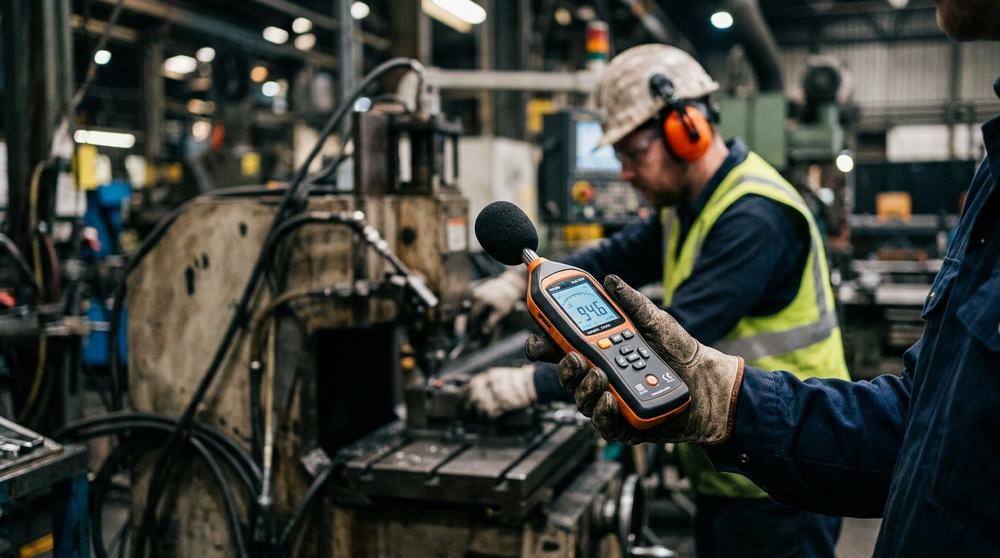
Some hazards are quantitative, and the calculator is the instrument: the noise exposure estimator with the TWA and the dose against the UK 85 and the OSHA 90, the manual handling assessment with the NIOSH lifting equation and the TILE, and the DSE assessment with the automatic recommendations. Each one shows the formula with the substitution, so the number is not a black box — the assessor can defend it.
The calculator is the difference between the number and the judgement. The noise exposure estimator sums the day in energy — the 16.61 log10 formula with the substitution — and tells you the position against the UK 85 and the OSHA 90 at the same time, so the re-measure after the extract is the proof, not the opinion. The manual handling assessment runs the NIOSH lifting equation — the six multipliers against the 23 kg constant — and the ratio of the load to the RWL is the band, with the TILE for the factors the equation does not see: the heat, the floor, the person. The DSE assessment is the one the back pain is about — the screen at eye level, the chair with the lumbar, the 500 lux on the task — and the recommendations build themselves from the fails, so the report says what to buy, not just what is wrong. When the auditor asks for the number, the answer is the formula with your numbers in it — and that is what this category is for.
Every tool in this category works the same way: it runs in your browser, it scores or checks as you go, nothing is uploaded, and it prints as a signed, dated document you can file. The professional version — the sign-off, the audit, the training — runs through umer-hse.pro.
The calculator exists where the hazard is quantitative, and the number has to be defensible. The noise exposure estimator runs the 8-hour time weighted average against the UK action levels — 80 dB(A) lower, 85 dB(A) upper — and against the OSHA pair of 90 and 85. The difference matters: the UK doubles the dose every 3 dB, the US every 5 dB, so the same shift can be compliant on one side of the Atlantic and over on the other. The manual handling assessment runs the NIOSH lifting equation — the load constant times the six multipliers — and the DSE assessment runs the task analysis with the recommendations built in. Each one shows the formula with the numbers in it, so the assessor can defend the result.
When the law wants the number, the calculation is not optional. The Control of Noise at Work Regulations 2005 require the exposure to be assessed, and where the upper action level is exceeded, the employer must take steps to reduce it to as low as is reasonably practicable. The gas checks have their own numbers — oxygen at 19.5 to 23.5 per cent, the lower explosive limit under 10 per cent, carbon monoxide under 30 ppm, hydrogen sulphide under 10 ppm — and the number on the meter has to be written down before the entry, not after. A calculator result without the time, the place and the person who read it is a number, not an assessment.
The limit of the calculator is the limit of the method. The area meter gives the zone, the personal sample gives the individual — and the regulation usually wants the individual. The lifting equation gives the load limit, not the back — the TILE is the physical test. The tool gives the defensible number; the judgement is still the assessor's. Use the calculator to set the number, the method to hold it, and the review to keep it honest.
- The UK doubles the dose every 3 dB, the US every 5 dB — the same shift can sit on different sides of the limit
- The noise action levels: 80 and 85 dB(A) in the UK, 85 and 90 in the US
- The gas numbers: oxygen 19.5 to 23.5 per cent, LEL under 10, carbon monoxide under 30 ppm, H2S under 10 ppm
- The number without the time, the place and the reader is a number, not an assessment
3 tools
The Calculators & Assessments range
Noise Exposure Estimator
Free noise exposure calculator: enter the levels and the times, get the 8-hour TWA, the OSHA dose, and the act
Calculators & AssessmentsManual Handling Assessment
Free manual handling risk assessment: the NIOSH lifting equation calculator with your numbers, the TILE task c
Calculators & AssessmentsDSE Assessment
Free DSE assessment tool: the workstation, the screen, the chair, the desk, the lighting and the breaks
Not sure which tool fits your job? Ask Muhammad Umer — one conversation maps the tool to the task.
Safety disclaimer
These tools are practical guidance, built to the UK baseline with the US equivalents named on each page. They do not replace a competent person assessment for high-risk work, a statutory assessment, or the advice of your insurer. Where a document has legal force — the fire risk assessment, the COSHH register, the permit to work — the responsible person owns it. Use the tool as the preparation, and the competent person as the sign-off.