
Free HSE tool · Calculators & Assessments
Manual Handling Assessment
Manual handling injury is the most reported workplace injury in most industrial countries — the back, the shoulder, the hand — and the handling assessment is the document that separates the task that is safe from the task that is a waiting incident. It has two instruments: the TILE assessment (Task, Individual, Load, Environment) for the judgement, and the NIOSH lifting equation for the number.
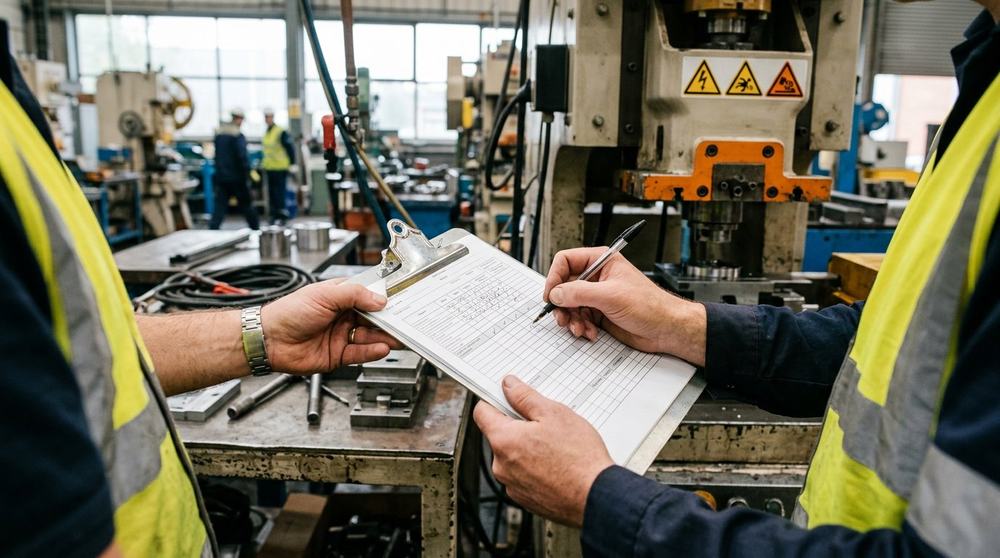
Free Manual Handling Assessment (NIOSH + TILE)
The NIOSH lifting equation with your numbers — the RWL, the ratio, the band — then the TILE checklist for the factors the equation does not see.
TILE checklist (the factors the equation does not cover)
Use both below: run the NIOSH equation with the load and the task numbers — it returns the recommended weight limit (the RWL) and the risk band from the ratio of the actual load to the RWL — then work the TILE checklist for the factors the equation does not see. Print the assessment and the control plan as one document.
How to use the tool
- Set up the task — the load weight, the horizontal distance from the body, the vertical origin, the travel distance, the asymmetry, the frequency, the coupling
- Run the NIOSH equation — the tool calculates the RWL and the ratio, and names the band
- Work the TILE checklist — the Task, the Individual, the Load, the Environment: the factors the equation does not cover
- Select the controls for the band — team lift, mechanical aid, redesign, rotation — in hierarchy order
- Print the assessment and the control plan, and brief the people who do the task on the method
Worked example
A casting transfer: 28 kg, origin 40 cm, horizontal 30 cm at the origin, travel 120 cm, no asymmetry, 3 lifts a minute, fair coupling (the casting is hot at the near end — fair, not good). The tool: RWL = 10.2 kg (the equation substitution shown below), ratio = 28 / 10.2 = 2.7 — the very-high band: the task should not continue as a manual lift at this frequency. The TILE adds the heat (the Individual and the Load flags) and the floor near the transfer point (the Environment). Controls: the vacuum lifter (the engineering move that removes the 28 kg entirely), and for the remaining manual tasks the rotation to 40 minutes with the rest, the floor marking. The re-assessment after the lifter: the RWL question is gone — the mechanical aid carries the load — and the TILE is the residual, which is the low one.
Standard & legal context
The UK Manual Handling Operations Regulations 1992 set the duty — avoid heavy manual handling where reasonably practicable, and assess where it cannot be avoided; the HSE TILE guidance is the method. The NIOSH lifting equation is the US reference — the recommended weight limit from the six multipliers — and is used worldwide as the quantitative half of the assessment. ISO 45001 risk management covers the handling task within the general hazard identification. The tool combines the two: the equation for the number, the TILE for the judgement.
Common mistakes
- Assessing the load and not the task — the weight is half the question; the distance, the twist, the frequency and the floor are the other half, and they are in the equation and the TILE
- It is only 15 kg — the light tasks with the twist and the frequency are the ones that injure; the equation says so, and the TILE confirms it
- PPE as the control — the lifting belt is not a control for the load; the belt is the last layer and a weak one at that
- One assessment for every task — the 28 kg casting and the 5 kg box are different tasks; the assessment is per task, and the task change re-assesses
Need the sign-off, not just the tool?
The tool is the preparation; the sign-off is the professional. For the statutory assessments, the audits, the ISO 45001 implementation and the training that comes with them, ask Muhammad Umer — 8+ years across Iraq, KSA and Pakistan, and the programme runs through umer-hse.pro. One message gets the written scope.
Common questions
Manual Handling Assessment — answered
What is a manual handling risk assessment?
The assessment of the handling task — the load, the distance, the twist, the frequency, the person, the environment — using the TILE method and, where a number is wanted, the NIOSH lifting equation. It is the document behind the handling injury prevention duty.
What is the NIOSH lifting equation?
The equation that calculates the Recommended Weight Limit (RWL) from six multipliers — the horizontal, the vertical, the distance, the asymmetry, the frequency, the coupling — against a 23 kg constant. The ratio of the actual load to the RWL sets the risk band: under 1 acceptable, 1–1.5 moderate, 1.5–2 high, over 2 very high.
What is a safe lifting weight?
There is no single number — the NIOSH constant is 23 kg as the starting point, and the multipliers adjust it down for the task. A 23 kg load at the hip, straight ahead, good grip, once a minute is near the limit; the same load twisted 90 degrees at knee height, six times a minute, is far over it. The tool calculates the tasks RWL.
Who needs a manual handling assessment?
Anyone who handles — the duty is on the task, not the headcount. The HSE guidance and the UK regulations expect the assessment where the handling cannot be avoided, and the high-injury tasks (the hospital, the warehouse, the workshop) get it by default.
Is a lifting belt a control?
No — the evidence does not support the belt as an injury-prevention control, and it is not a substitute for the mechanical aid, the redesign or the rotation. It is the last, weakest layer, and some regulators do not recommend it at all.
Can I print the handling assessment?
Yes — the Print button produces the equation with the substitution, the RWL and the band, the TILE checklist with the flags, the controls and the briefing note. It is the document the task is briefed from and the one the investigator asks for.
Keep building
Related tools
General Risk Assessment
Free 5-step general risk assessment tool: identify hazards, who is harmed, score the risk, select controls and
Risk AssessmentsJob Safety Analysis (JSA/JHA)
Free job safety analysis tool: break the job into steps, list the hazards, existing controls, add new controls
Inspections & ChecklistsPPE Inspection Checklist
Free PPE inspection checklist: hard hats, gloves, boots, eye and respiratory protection, harnesses and high-vi
THE HEALTH AND SAFETY is an education and knowledge network. The tools are free and open; the professional assessments and audits run through umer-hse.pro.
Safety disclaimer
These tools are practical guidance, built to the UK baseline with the US equivalents named on each page. They do not replace a competent person assessment for high-risk work, a statutory assessment, or the advice of your insurer. Where a document has legal force — the fire risk assessment, the COSHH register, the permit to work — the responsible person owns it. Use the tool as the preparation, and the competent person as the sign-off.