
Resources · 5 templates
JSA Template: the Blank Form, How to Fill, and the Examples
The job safety analysis, step by step: break the job into steps, name the hazard of each, put the controls in order, score it, and the crew signs before the first step.

The JSA templates are the job-level risk assessment as documents: the steps, the hazards, the existing controls, the new controls, the score per step, and the sign-off. This category is the JSA in its document forms: the standard JSA with the worked example, the blank form for the field, the filled-in example to learn from, the electrical JSA with the LOTO sequence, and the construction JSA with the site sequence. Each one is the JSA method, the five steps applied to the task, in the form the job needs.
Which JSA for which job: the standard JSA template is the interactive version with the worked example, for the file. The blank JSA form is the minimal printable version for the hand, the one that goes in the site office folder. The filled-in example is the finished JSA for a work-at-height job, for reading before the first one is written. The electrical JSA carries the isolation, the try-out and the test-before-touch as fixed steps. And the construction JSA carries the ground, the excavation and the lift as the site sequence. The five are the JSA, in the forms the job needs.
Every template in this category works the same way: fill it in in your browser, add or remove the lines the job needs, print it as a signed, dated document or export the rows to CSV. Nothing is uploaded and there is no account. The professional version — the sign-off, the audit, the training — runs through umer-hse.pro.
The job safety analysis is the plan for the hands, and it runs on six steps: break the task into steps, find the hazard in each step, write the control against the step, name the person who does it, set the stop-work condition, and review when the task changes. The JSA is different from the risk assessment in one way that matters — the risk assessment covers the workplace, the JSA covers the task. A site can pass the risk assessment and still fail the JSA, because the assessment said the plant was safe and the task said the hands were not.
The OSHA side calls it the job hazard analysis, and it runs on the same logic — the step, the hazard, the control, the person. The difference is the depth: the OSHA JHA is the working document on the floor, and the UK JSA is the working document plus the record for the audit. The JSA that holds is the one the crew wrote with the supervisor, not the one the office wrote for the crew — the steps are the crew's steps, the hazards are the crew's hazards, and the controls are the ones the crew will actually use.
The templates in this section are the working JSAs: the standard form, the blank form, and the worked example. Each one is printable and editable, with the steps blank for the crew and the control column built for the hierarchy. The permit that the JSA feeds is in the Toolkit, and the professional preparation for the high-risk task runs through umer-hse.pro.
- The six steps: break the task, find the hazard, write the control, name the person, set the stop condition, review
- The JSA covers the task; the risk assessment covers the workplace — both are needed
- The crew writes the JSA with the supervisor — the steps are the crew's steps
- The JSA feeds the permit: the same controls, the two documents
5 templates
The JSA / JHA Forms range
JSA / JHA Template
Free JSA template (job safety analysis / job hazard analysis): the steps, the hazards, the existing controls,
JSA / JHA FormsBlank JSA Form
A blank JSA form you can print and fill in by hand: the job header, the step table, the sign-off lines
JSA / JHA FormsJSA Example (Filled-In)
A filled-in JSA example for a work-at-height job: every step, hazard, control and score worked through, so you
JSA / JHA FormsElectrical JSA Template
Free electrical JSA template: the isolation, the lockout-tagout, the arc-flash PPE, the test-before-touch and
JSA / JHA FormsConstruction JSA Template
Free construction JSA template: the ground, the excavation, the crane, the working at height and the housekeep
Not sure which template fits your job? Ask Muhammad Umer — one conversation maps the template to the task.
Safety disclaimer
These templates are practical documents, built to the UK baseline with the US equivalents named on each page. They do not replace a competent person assessment for high-risk work, a statutory assessment, or the advice of your insurer. Where a document has legal force — the fire risk assessment, the COSHH register, the permit to work — the responsible person owns it. Use the template as the preparation, and the competent person as the sign-off.
What Is a JSA (Job Safety Analysis)?
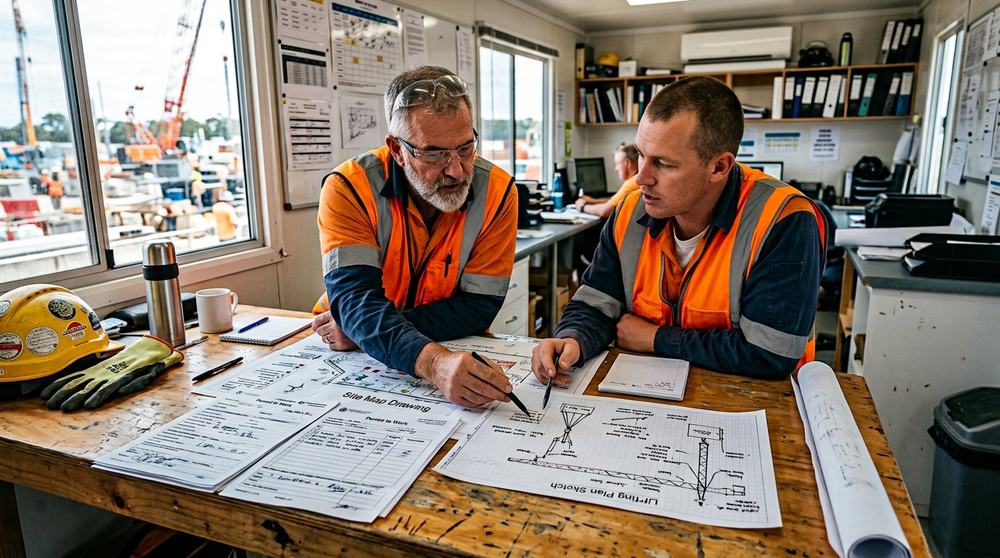
A JSA — the job safety analysis, called the job hazard analysis (JHA) in the US — is the plan for the hands. It breaks a task into steps, finds the hazard in each step, and writes the control against the step, so the crew can walk the task before the task walks them. The JSA is not the risk assessment: the risk assessment covers the workplace, the JSA covers the task. The JSA is written by the crew with the supervisor, on the floor, before the task — the office that writes the JSA for the crew writes the document the crew does not use.
How to Fill Out a JSA Form (Step by Step)
The fill-in runs six steps, in order: 1 break the task into steps — the pour, the lift, the connect, in the order it is done, not the order it looks good; 2 find the hazard in each step — the load path, the voltage, the gap, the gas; 3 write the control against the step — the guard, the isolation, the tag, the watch; 4 name the person who does it — the step is the person's responsibility, not the crew's; 5 set the stop-work condition — the one that stops the task, the gas, the shift, the finding; and 6 review when the task changes — the changed task is the new JSA. The blank form on this page runs the six in the columns, and the worked example shows the same six filled for a live task.
JSA for Construction Work (and the Electrical JSA)
The construction JSA runs the steps of the build: the excavation and the shoring, the lifting and the slinging, the work at height and the edge, the hot work and the fire watch, the temporary power and the isolation. The electrical JSA adds the energy: the isolation point, the lock and the tag, the verification that the circuit is dead, the arc-flash boundary, and the re-energise in the order that is safe. Both are the same six steps on the same form — the hazard column is the one that changes with the task, and the control column is the one the auditor reads.
JSA vs JHA: Is There a Difference?
No — the JSA and the JHA are the same document, the two names for it. The UK and the Gulf use the JSA (the job safety analysis); the US uses the JHA (the job hazard analysis). The six steps, the hazard column, the control column, and the stop-work condition are the same on both sides of the Atlantic, and the form on this page is the one that works for both. The download, the print, and the edit are the same file — the name on the header is the one the site uses.
OSHA JSA Template (the US Site)
The OSHA side runs the same analysis under the general duty and the industry standards — the JHA is the working document on the floor, the one the OSHA inspection asks for first. The OSHA JSA template is the same six-step form, with the hazard against the OSHA standard (the 1910 series) in the control column. The form on this page is the OSHA JSA template and the JSA template on the same paper — the standard cited in the control is the one that decides the side of the Atlantic.