
Article · Risk Assessment · 21 August 2026
What Is a Hazard? The Definition, the Six Types and Real Examples
A hazard is any source of potential damage, harm or injury — and in health and safety the word is wider than the everyday one. It is not just the visible object; it is the design of a process, the layout of a site, the pattern of a shift. This article is the working definition: the HSE wording, the six families of hazard with the examples that live in them, and the walkover method that finds them before they become the incident.
The definition, in the HSE words
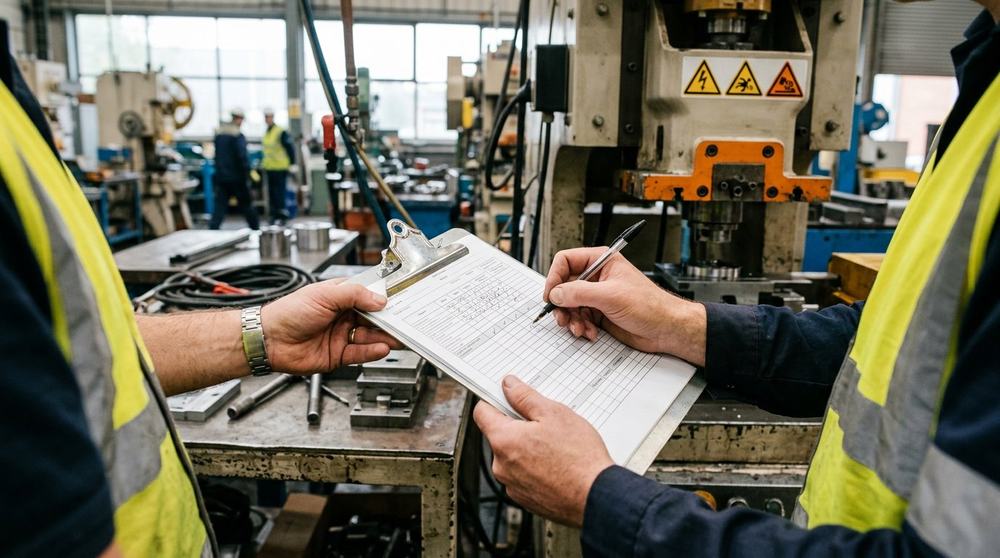
The HSE definition is short and it is the one to use: a hazard is any source of potential damage, harm or injury. The UK law puts it at the start of the duty. The Management of Health and Safety at Work Regulations 1999 require every employer to make a suitable and sufficient assessment of the risks to the health and safety of the people — and the first verb of that assessment is to identify the hazards. No hazard found, nothing to assess.
The everyday word is narrower, and the difference matters. In speech, a hazard is a single dangerous object — the cliff, the live wire. In health and safety, the hazard is the source, and the source can be a substance, a practice, a design decision, a management decision. The solvent is a hazard; the lack of ventilation around it is a hazard; the shift pattern that puts the same person on the line for twelve hours is a hazard. The walkover that only looks for the objects finds a fraction of the list.
Hold the definition as a question: what here has the potential to harm a person? Ask it of the object, the substance, the method, the arrangement — and the answer is the hazard.
The six families of hazard
The working assessor does not walk the site with one idea of a hazard; they walk it with six, and ask for each family in turn. The six families are the physical, the chemical, the biological, the ergonomic, the psychosocial, and the work-organisation hazards.
| Family | What it is | Workplace examples |
|---|---|---|
| Physical | Energy and conditions in the environment | Noise, vibration, heat and cold, electricity, moving machinery, height, radiation, housekeeping and slips |
| Chemical | Substances that can harm | Solvents, gases, dusts, fumes, acids, the COSHH substances |
| Biological | Living sources of harm | Bacteria, viruses, mould, animal waste, sharps in the clinical setting |
| Ergonomic | The fit between the person and the task | Manual handling, repetitive tasks, the screen at the wrong height, the chair, the workstation |
| Psychosocial | The mind at work | Stress, workload, violence and aggression, bullying, the culture that stops the report |
| Work organisation | How the work is arranged | Long hours, shift patterns, lone working, supervision gaps, the handover |
The families are not a taxonomy for the file; they are the checklist for the walkover. The assessor who walks for the physical only finds the press, the mezzanine and the forklift — and misses the stress, the handling and the lone working that the incident will come from. Walk the six, and the list comes out whole.
How to find hazards: the walkover method
Hazard identification is a method, not a memory. The walkover is the instrument: the slow walk of the workplace with the six families in mind, the interview with the people who do the work, and the read of the drawings, the permits and the incident history.
Walk the route the work actually takes, not the route the drawings intend. Look at the point of work, then the interfaces — the forklift and the pedestrian, the crane and the walkway, the solvent and the ignition source. Ask the crew the two questions that find what the eye misses: what has nearly gone wrong here? and what are you most worried about on this shift? The near-miss history is a hazard list that someone has already compiled, and the worry of the crew is the hazard the assessor has not seen.
Then write it down. The hazard that is not recorded is not identified: the MHSWR require the findings recorded where the business has five or more people, and the investigation will read the list, not the memory. The record is the line per hazard: the source, who is exposed, what is in place, what is not.
Hazard vs the words around it
The definition sits inside a family of words that the test and the interview keep mixing, and the cleanest way to hold them is the chain. The hazard is the source — the wet floor, the crane, the solvent. The risk is the likelihood that the hazard causes harm, multiplied by the severity. The danger is the state of being exposed — the position in the crane radius, the breath of the vapour.
A harm is what actually happens to a person when the risk materialises: the broken bone, the dermatitis, the hearing loss. A safety hazard is the physical source that the site walk finds; a health hazard is the source that acts slowly — the dust, the chemical, the noise — and the difference matters because the health hazard is the one the walkover misses and the health surveillance catches.
The chain in one line: the hazard is the source, the risk is the likelihood and severity, the danger is the exposure, the harm is the result. Remove the exposure — barrier the radius, ventilate the vapour — and you remove the danger without touching the hazard. That is the logic of the control hierarchy in one sentence.
Worked example: the loading bay
A loading bay, walked for the six families, and the list that comes out.
| Family | Hazard found on the walkover | Who is exposed |
|---|---|---|
| Physical | Truck reversing at the dock; the open dock edge | Drivers, the dock crew |
| Physical | Wet floor from the rain; the housekeeping of the pallets | All who cross |
| Chemical | Adhesive and solvent in the packing area | The packers |
| Ergonomic | The 18-kg carton to the high shelf; the repetitive scan | The packers |
| Psychosocial | The peak-day workload; the pressure to skip the check | The whole team |
| Work organisation | The night shift of two; the handover at the changeover | The night crew |
Six lines from one bay, from one walk. The physical lines are the ones everyone finds; the last two are the ones the incident comes from. The list is now the input to the risk assessment — each line scored on the matrix, each high line getting the control, the owner and the date. The hazard identification did its job: the eye found the source. The assessment does the rest.
The mistakes that hide the hazard
The hazards that are missed are missed for a small set of repeatable reasons. The walk is too fast: the ten-minute walk finds the object and misses the arrangement — the solvent is seen, the lack of ventilation around it is not. The six families are not all asked: the physical is looked for, the psychosocial and the work-organisation are not even asked about. The crew is not asked: the near-miss history and the shift worry are the two richest sources, and the walkover that skips the interview skips them.
The record is not written: the hazard that is not recorded is not identified, and the review has nothing to work from. The change is not re-walked: the new machine, the new product, the new shift pattern — the hazard that arrives with the change is the one the old assessment does not see, and the MHSWR put the re-assessment on the change, not on the calendar alone.
The walkover is the cheapest instrument in the whole system, and the one that is done least carefully. The six families, the slow walk, the two questions, the written record — that is the method, and it is the start of the assessment.
Need the sign-off, not just the article?
The article is the preparation; the sign-off is the professional. For the statutory assessments, the audits, the ISO 45001 implementation and the training that comes with them, ask Muhammad Umer — 8+ years across Iraq, KSA and Pakistan, and the programme runs through umer-hse.pro. One message gets the written scope.
Common questions
What Is a Hazard? The Definition, the Six Types and Real Examples — answered
What is a hazard in health and safety?
Any source of potential damage, harm or injury. The HSE definition is wider than the everyday word: it includes the substances, the equipment, the layout, the work organisation and the psychosocial conditions, not just the visible objects.
What are the types of hazards?
Six families: physical (noise, electricity, height, housekeeping), chemical (solvents, gases, dusts), biological (bacteria, mould), ergonomic (handling, repetitive tasks, the workstation), psychosocial (stress, violence), and work organisation (shift patterns, lone working).
What is the difference between a safety hazard and a health hazard?
A safety hazard is the physical source the site walk finds — the machine, the height, the electricity — and the harm is immediate. A health hazard is the source that acts slowly — the dust, the chemical, the noise — and the harm is the dermatitis, the lung disease, the hearing loss. The health hazard is the one the walkover misses and the health surveillance catches.
How do you identify hazards in the workplace?
With the walkover: the slow walk with the six families in mind, the interview with the crew (what has nearly gone wrong, what worries you on this shift), and the read of the drawings, the permits and the incident history. Then write the list down — the hazard that is not recorded is not identified.
Is a hazard the same as a risk?
No. The hazard is the source; the risk is the likelihood that the hazard causes harm, multiplied by the severity. One hazard carries several risks, and the same hazard carries a different risk in different conditions. The hazard is found by identification; the risk is scored by the assessment.
What are examples of hazards in the workplace?
The press (caught-in), the mezzanine edge (fall), the forklift route (struck-by), the solvent (inhalation and skin), the 18-kg carton (manual handling), the peak-day workload (stress), the night shift of two (lone working). The families are the checklist; the walkover finds them.
Why is hazard identification important?
Because it is the first step of the risk assessment under the MHSWR, and the controls come from the list. A hazard that is not identified is not assessed, not controlled, and not reviewed — and the incident comes from the line that was never written down.
Keep reading
Related articles
Hazard vs Risk: The Difference, Explained With Examples
Hazard vs risk, explained: what each term means in health and safety, the difference between hazard and risk w
Risk Assessment · 19 August 2026How to Do a Risk Assessment in the Workplace (5-Step, Practical)
How to do a risk assessment in the workplace: the 5-step method, what to look for on the walkover, how to scor
Risk Assessment · 23 August 2026What Is Risk in Health and Safety? The Definition, the Formula, the Rating
What is risk in health and safety? The definition, the likelihood × consequence formula, the 5×5 rating bands,
THE HEALTH AND SAFETY is an education and knowledge network. The articles are free and open; the professional assessments and the training run through umer-hse.pro.
Safety disclaimer
The articles on this blog are practical guidance, built to the UK baseline with the US equivalents named in the text. They do not replace a competent person assessment for high-risk work, a statutory assessment, or the advice of your insurer. Where a duty has legal force — the fire risk assessment, the risk assessment, the COSHH register — the responsible person owns it. Read the article as the preparation, and take the sign-off from the competent person.