
Article · Risk Assessment · 19 August 2026
Hazard vs Risk: The Difference, Explained With Examples
Two words that everyone in health and safety uses every day, and almost nobody can keep apart on a test or in front of an auditor. A hazard is the thing that can do the harm. A risk is the chance that it actually does, multiplied by how bad it would be if it did. Once you can hold the two apart, hazard identification, risk assessment and the whole MHSWR duty fall into place — and this article is the one that puts them apart for good.
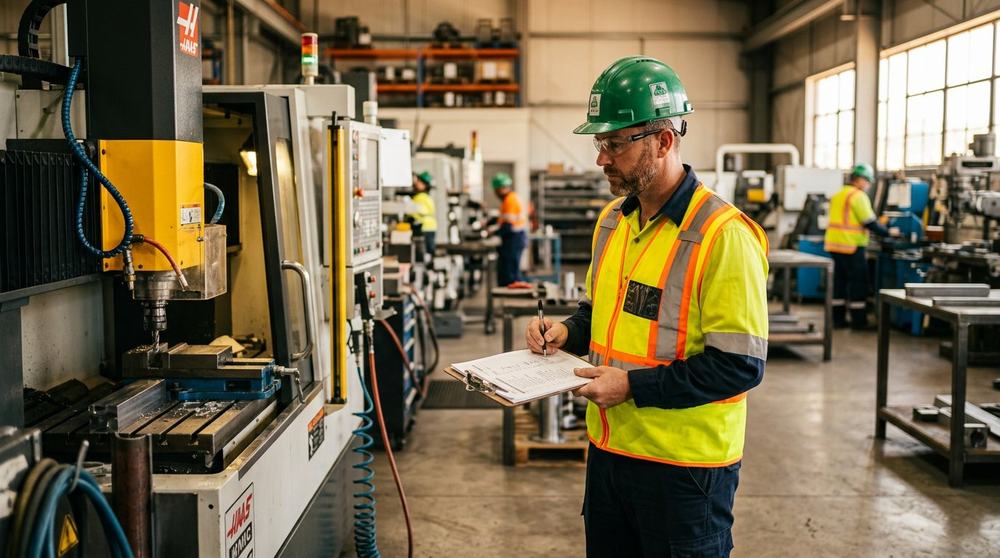
The answer in 30 seconds
A hazard is anything with the potential to cause harm: a substance, a situation, a piece of equipment, a practice. The HSE definition is the one that sticks: any source of potential damage, harm or injury.
A risk is the possibility of something bad happening — the likelihood that the hazard causes harm, combined with the severity of that harm. Risk is the hazard put into numbers: usually likelihood times consequence, on a 5×5 matrix.
The cleanest way to remember it: the hazard is the thing, the risk is the bet. The wet floor is the hazard. The chance someone slips on it, and how badly, is the risk.
Hazard: the definition, and the six families
In health and safety the word hazard is broader than in everyday speech. Where a layman means a single dangerous object, the HSE means any source of potential damage, harm or injury — and that includes the design of a process, the culture of a shift, the layout of a site. The UK Management of Health and Safety at Work Regulations 1999 put hazard identification at the start of every assessment: you cannot assess the risk of a hazard you have not found.
Hazards fall into six families, and a working assessor walks the workplace asking for all six. Physical hazards: the noise, the vibration, the heat, the electricity, the moving machinery, the height. Chemical hazards: the solvents, the gases, the dusts, the fumes — the family the COSHH Regulations exist for. Biological hazards: the bacteria, the viruses, the mould, the animal waste. Ergonomic hazards: the manual handling, the repetitive task, the screen at the wrong height, the chair with no lumbar. Psychosocial hazards: the stress, the workload, the violence and aggression at work. Work organisation hazards: the long hours, the lone working, the shift pattern, the lack of supervision.
The list is not decoration. The assessor who only walks the site for the physical hazards finds the press and the mezzanine and misses the stress, the handling and the lone working — and the assessment fails the moment the incident comes from the family that was not looked for.
Risk: the definition, and the number behind it
Risk is the hazard put into a number, and the number has two halves. The first half is likelihood — how probable is it that the hazard causes harm, on a scale from rare to almost certain. The second half is consequence — if it does happen, how bad is it, from a minor first aid to a fatality.
Multiply the two and you get the risk rating: on the standard 5×5 matrix, 1 to 4 is low, 5 to 9 is medium, 10 to 15 is high, 16 to 25 is very high. The same hazard carries a different risk in different places: a 20-litre drum of solvent in a locked, ventilated store is a low risk; the same drum open on a bench in a busy workshop is a high one. The hazard did not change. The likelihood and the consequence did.
That is why risk is the word that drives the action. The hazard tells you what to look at; the risk tells you what to do first. The high and very high lines get the controls, the owner and the date — the low lines get the monitor and the review.
Hazard vs risk: the side-by-side
Set the two definitions next to each other and the difference stops being a memory trick and becomes a working rule.
| Hazard | Risk | |
|---|---|---|
| What it is | A source of potential harm | The chance of harm, and its severity |
| Asks the question | What can hurt people? | How likely, and how bad? |
| Example | A wet floor | The slip: likelihood × consequence |
| Example | An overhead crane | The dropped load over the walkway |
| Example | A solvent | The vapour: exposure × effect |
| Measured by | Identification (the walkover) | Assessment (the matrix) |
| Drives | What to assess | What to control first |
Notice the last row. The hazard decides what goes into the assessment; the risk decides what the assessment does about it. An auditor who asks "where is the risk?" and gets "the wet floor" has caught the classic mix-up — the wet floor is the hazard, and the slip that could come from it is the risk.
Hazard identification vs risk assessment: the sequence
The confusion extends past the two words, into the two processes. Hazard identification is the first step of a risk assessment, not a different thing. Under the UK system it is step one of the five-step method: identify the hazards, decide who might be harmed, evaluate the risks, record the findings, review them.
Hazard identification is the walkover with the six families in mind, the interview with the crew, the read of the drawings and the history. Its output is a list: the wet floor, the crane, the solvent, the stress. Risk assessment is the whole job: take that list, put each line into likelihood and consequence, score it, decide the controls, record it, review it. The MHSWR require the assessment where the business has five or more people; the COSHH assessment is the chemical version of the same sequence, substance by substance.
So "hazard vs risk assessment" is not a either-or. The hazard identification is the eye; the risk assessment is the eye and the brain together. A site that does the walkover and stops there has identified hazards and assessed nothing. A site that scores lines it has not found has assessed a fiction.
Worked example: one workshop, both words
Take a working example the size of a small workshop, and watch the two words do their separate jobs.
| Hazard (the thing) | Who may be harmed | Risk before controls (L×C) | Rating | Control (what moves the risk) |
|---|---|---|---|---|
| Press — caught-in | Operators | 4 × 5 = 20 | Very High | Interlocked guard |
| Mezzanine edge — fall | All workshop staff | 3 × 5 = 15 | High | Guard rail and toe board |
| Forklift route — struck-by | Pedestrians | 3 × 4 = 12 | High | Barrier and one-way route |
| Casting — manual handling | Operators | 3 × 3 = 9 | Medium | Vacuum lifter |
| Welding floor — slip | All | 2 × 2 = 4 | Low | Annual review |
Five hazards, five risks, five different answers to the question "what do we do first." The press is the hazard everyone sees; the 20 is the number that tells the manager the guard is not optional. The slip is a hazard too — and the 4 tells the manager it is the last one to spend money on. The two words, doing the two jobs.
And what is a danger, then?
The long tail of the question adds a third word: the danger. If the hazard is the source and the risk is the chance, the danger is the state of being exposed to harm — the position, not the thing. Standing in the crane radius is a danger; the crane is a hazard; the chance and the severity of the dropped load is the risk.
The three words are the chain: the hazard is the source, the risk is the likelihood and severity, the danger is the exposure that the worker is actually in. Remove the exposure — barrier the radius, de-energise the panel, ventilate the vapour — and you have removed the danger without touching the hazard at all. That is the logic of the control hierarchy in one sentence: where you cannot remove the hazard, remove the exposure.
How to remember it
Three anchors, and the interview answer writes itself. One: hazard is the thing, risk is the bet — the wet floor, and the slip that could come from it. Two: the hazard is found by the walkover across the six families; the risk is the likelihood times the consequence on the matrix. Three: the hazard decides what to assess, the risk decides what to control first.
Use that in the interview and it is the answer that separates the person who has done the work from the person who has read the definition. The auditor asks "is the crane a hazard or a risk?" and the person who has worked the site answers "the crane is the hazard; the dropped load over the walkway is the risk — and here is the score and the control." The difference, held apart, is the whole job.
Need the sign-off, not just the article?
The article is the preparation; the sign-off is the professional. For the statutory assessments, the audits, the ISO 45001 implementation and the training that comes with them, ask Muhammad Umer — 8+ years across Iraq, KSA and Pakistan, and the programme runs through umer-hse.pro. One message gets the written scope.
Common questions
Hazard vs Risk — answered
What is the difference between a hazard and a risk?
A hazard is any source of potential damage, harm or injury — the thing. A risk is the possibility of harm: the likelihood that the hazard causes harm, combined with the severity of the harm. The wet floor is the hazard; the slip is the risk.
What is a hazard in health and safety?
Any source of potential damage, harm or injury. It is wider than the everyday word: it includes the substances, the equipment, the layout, the work organisation and the psychosocial conditions, not just the visible objects.
What is the difference between hazard and risk with an example?
Example: an overhead crane. The crane is the hazard. The dropped load over the walkway is the risk — the likelihood a load is dropped, multiplied by the severity if one is. The control is the exclusion zone and the load path, which moves the risk down.
Is a hazard the same as a risk?
No. The hazard is the source; the risk is the chance and the severity. One hazard can carry several risks at different ratings, and the same hazard carries a different risk in different conditions — locked and ventilated is not the same risk as open on the bench.
What is the difference between hazard identification and risk assessment?
Hazard identification is the first step of a risk assessment: finding the hazards by the walkover across the six families. Risk assessment is the whole process — identify, evaluate on the matrix, record, control, review. The identification is the eye; the assessment is the eye and the brain.
What is a danger, and how is it different from a hazard?
The danger is the state of being exposed to harm — the position, not the thing. Standing in the crane radius is a danger; the crane is the hazard; the dropped load is the risk. Remove the exposure and you remove the danger without removing the hazard.
How do you calculate risk?
Multiply the likelihood (1 rare to 5 almost certain) by the consequence (1 negligible to 5 catastrophic). The product on a 5×5 matrix gives the rating: 1–4 low, 5–9 medium, 10–15 high, 16–25 very high. The rating sets the order of the controls.
Why is the difference between hazard and risk important?
Because the two words drive two different actions. The hazard tells you what to look at; the risk tells you what to do first. A site that identifies hazards but never scores the risks has done the walkover and stopped; the controls come from the score, not from the list.
Keep reading
Related articles
What Is a Hazard? The Definition, the Six Types and Real Examples
What is a hazard in health and safety? The HSE definition, the six types of hazard with workplace examples, an
Risk Assessment · 19 August 2026How to Do a Risk Assessment in the Workplace (5-Step, Practical)
How to do a risk assessment in the workplace: the 5-step method, what to look for on the walkover, how to scor
Workplace Safety · 19 August 2026Near Miss Reporting: Why the Almost-Incidents Are the Ones That Matter
Near miss reporting, explained: what a near miss is, why the almost-incidents are the leading indicator, how t
THE HEALTH AND SAFETY is an education and knowledge network. The articles are free and open; the professional assessments and the training run through umer-hse.pro.
Safety disclaimer
The articles on this blog are practical guidance, built to the UK baseline with the US equivalents named in the text. They do not replace a competent person assessment for high-risk work, a statutory assessment, or the advice of your insurer. Where a duty has legal force — the fire risk assessment, the risk assessment, the COSHH register — the responsible person owns it. Read the article as the preparation, and take the sign-off from the competent person.