
Free HSE tool · Reports & Data
Incident Report
The incident report is the document every investigation hangs on — and the one that is written under the worst conditions, minutes after the event, when the facts are fresh and the pressure is to get back to work. A good report is factual, complete, and honest about the causes; a bad one is a liability. This form is built for the field: the facts first, the first aid, the witnesses, then the cause work — the 5-Why that gets from the event to the root — and the corrective actions with the owners and the dates.
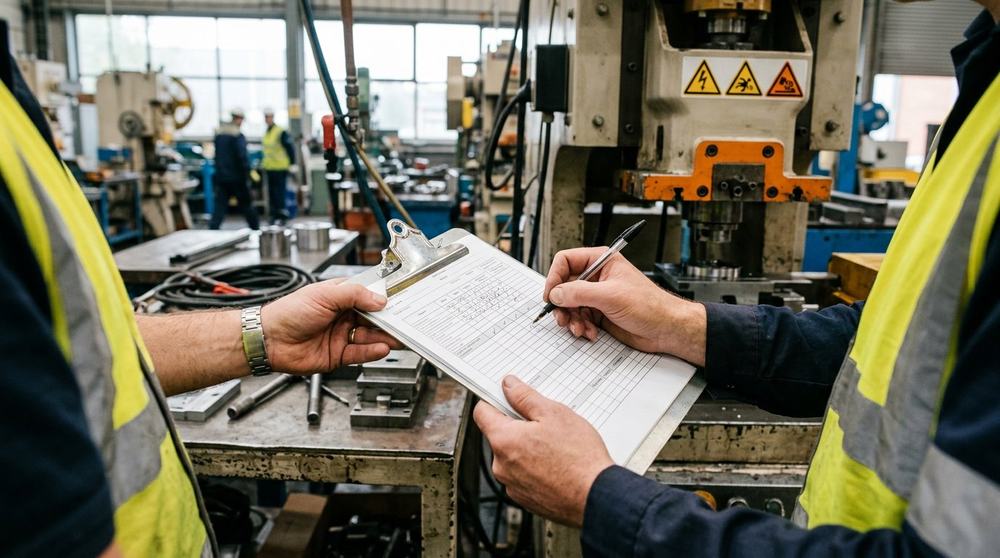
Free HSE Incident Report (with 5-Why & RIDDOR check)
The facts first, the causes second — the 5-Why gets from the event to the system, and the RIDDOR check says what is reportable.
Contributing factors
The 5-Why (from the event to the system)
Corrective actions
| Action | Owner | Due |
|---|
RIDDOR check (UK reportability)
Complete the form below, run the RIDDOR check (the UK reportability test, with the note for the other jurisdictions), and print the signed report. The 5-Why section is where the report earns its keep: the five whys that take the near miss or the injury from it happened to here is the system failure, and here is the fix.
How to use the tool
- Record the facts first — the date, time, location, the people, the type: incident, first-aid case, dangerous occurrence, or near miss
- Write the description in the order it happened — the facts, not the interpretation; save the causes for the cause section
- Record the immediate actions and the first aid — what was done, by whom, and the medical follow-up
- Work the 5-Why — ask why five times, from the event to the system: the tool provides the five lines and the example
- Complete the corrective actions (the action, the owner, the date) and run the RIDDOR check — then print and file the signed report
Worked example
A forklift reverses and clips a pallet stack; a pedestrian is pushed back, no injury — a near miss with the potential for the serious. Facts: 14:20, the dock, the forklift and the pedestrian, no PPE issue. Immediate: the area cleared, the forklift parked, the brief re-run. 5-Why: why was the pedestrian in the path? — the route crossed the forklift line. Why did the route cross? — the loading bay was repurposed without the route review. Why no route review? — the change was made by the logistics team, not through the safety change control. Why no change control? — the procedure does not require it for layout changes. Why? — the procedure predates the layout changes and was never updated. Root: the change control gap. Actions: the route re-marked and the barrier installed (this week), the change control updated to include layout (this month), the toolbox talk (today). RIDDOR: the near miss is not reportable, but the potential is recorded in the near-miss register and the trend. The report is the document that makes the barrier happen.

Standard & legal context
In the UK, RIDDOR 2013 (the Reporting of Injuries, Diseases and Dangerous Occurrences Regulations) sets the reportability: the specified injuries, the deaths, the 7-day injuries, the dangerous occurrences, and the specified diseases — to the HSE, with the timescales. The US pair is the OSHA 300/301 recordkeeping and the 300A summary, with the fatality (8 hours) and the in-patient hospitalisation, amputation and loss of an eye (24 hours) reportable to OSHA. ISO 45001 clause 10.2 requires the investigation of the incidents and the near misses, with the corrective action. The 5-Why is the standard root-cause method taught in the IOSH and NEBOSH incident investigation units; the form below is the UK RIDDOR structure with the international columns.
Common mistakes
- Writing the blame into the report — the report is the facts and the system; the blame is the discipline, and the report that names the fault before the cause is the report the witness stops trusting
- Stopping at the immediate cause — the worker slipped is the event; the five whys are the wet floor, the no-drain, the no-report, the no-inspection, the no-system — the fix is at the bottom, not the top
- Leaving the corrective action ownerless — an action without an owner and a date is a note, and the near-miss register is where the unowned actions go to die
- Not using the near misses — the near miss is the free incident; the register and the trend are the early warning, and the report that ends at the first-aid case leaves the trend un-built
Need the sign-off, not just the tool?
The tool is the preparation; the sign-off is the professional. For the statutory assessments, the audits, the ISO 45001 implementation and the training that comes with them, ask Muhammad Umer — 8+ years across Iraq, KSA and Pakistan, and the programme runs through umer-hse.pro. One message gets the written scope.
Common questions
Incident Report — answered
What should be in an incident report?
The facts (the date, time, location, the people, the type), the description in order, the immediate actions and the first aid, the witnesses, the cause work (the 5-Why or the equivalent), the corrective actions with the owners and the dates, and the reportability check — RIDDOR in the UK, the OSHA 300/301 in the US.
What is RIDDOR?
The Reporting of Injuries, Diseases and Dangerous Occurrences Regulations 2013 — the UK duty to report the specified injuries, the deaths, the 7-day injuries, the dangerous occurrences and the specified diseases to the HSE, with the timescales. The check on this form is the reportability test.
How long do I have to report under RIDDOR?
Deaths and the specified injuries and dangerous occurrences: as soon as practicable, without delay. The 7-day injuries (a day off work or off normal duties): within 15 days. The specified diseases: on the diagnosis. The report is to the HSE online.
What is the 5-Why method?
The root-cause technique that asks why five times, each answer leading to the next, from the event to the system failure. The example on this page shows the forklift near miss going from the pedestrian was in the path to the change control does not cover layout in five steps.
Is a near miss reportable?
Under RIDDOR, most near misses are not reportable — but they are recorded in the near-miss register, and the trend of the near misses is the leading indicator that predicts the incidents. The report on this form works for the near miss as well as the injury.
Can I print the incident report?
Yes — the Print button produces the full report: the facts, the description, the first aid, the 5-Why, the corrective actions, the RIDDOR check and the signature lines. It is the document the investigation, the insurer and the regulator all work from.
Keep building
Related tools
Near Miss Register
Free near miss reporting tool and register: report the near miss, log it with the potential and the action, an
Reports & DataHSE Incident Data Analysis
Build the HSE incident report in Power BI: the data model, the KPIs (TRIR, LTIR, the severity, the near-miss r
Risk AssessmentsGeneral Risk Assessment
Free 5-step general risk assessment tool: identify hazards, who is harmed, score the risk, select controls and
THE HEALTH AND SAFETY is an education and knowledge network. The tools are free and open; the professional assessments and audits run through umer-hse.pro.
Safety disclaimer
These tools are practical guidance, built to the UK baseline with the US equivalents named on each page. They do not replace a competent person assessment for high-risk work, a statutory assessment, or the advice of your insurer. Where a document has legal force — the fire risk assessment, the COSHH register, the permit to work — the responsible person owns it. Use the tool as the preparation, and the competent person as the sign-off.