
Guide · OSHA (US) · 4 September 2026
OSHA Focus Four: the Hazards That Kill, and the Controls
The OSHA focus four — called the fatal four — are the four hazards that kill the most in the construction industry: falls, struck-by, electrocution, and caught-in or between. The four are about 60 percent of the construction fatalities, and the controls are the ones that stop them. This guide is the focus four in working form — the hazard, the mechanism, the control, and the UK equivalent of each.
The focus four: the fatal four
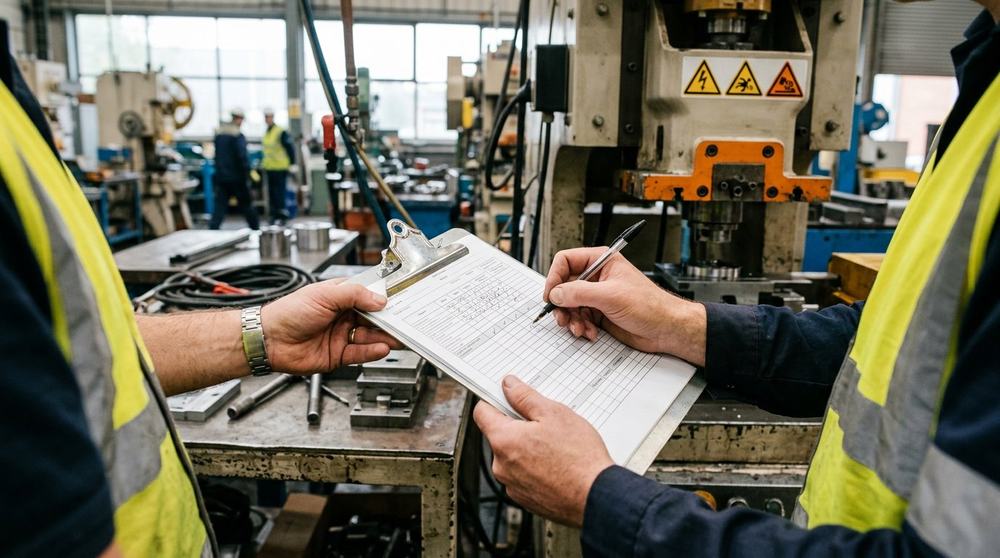
The OSHA focus four (the fatal four) are the four hazards that account for the majority of the construction fatalities — the typical number is 60 percent. The four are falls, struck-by, electrocution, and caught-in or between.
The focus four is the OSHA programme: the training and the enforcement are built around the four. The OSHA 10 and the OSHA 30 both cover them, and the construction worker who knows the four knows where the fatalities come from. Construction is the highest-fatality industry in the US, and the standard is the OSHA 1926 — the UK equivalent is the HSE construction enforcement and the CDM 2015.
Hazard 1 — the falls
The falls are the number-one cause of the construction fatality. The mechanisms are the roof, the ladder, the scaffold, the floor opening, and the leading edge — the height is what makes the fall fatal.
The control follows the hierarchy: the guardrail (the passive protection, the roof and the scaffold), the safety net (the collective protection below), the restraint (the do-not-fall, the roof), the arrest (the fall arrest, the leading edge), the cover (the floor opening, the secure), and the ladder (the three points, the secured top and bottom). The UK equivalent is the Work at Height Regulations: the avoid, the protect, the minimise.
Hazard 2 — the struck-by
The struck-by is the vehicle and the object on the construction site. The mechanisms are the reversing vehicle, the falling object, the swinging load, the vehicle at speed, and the equipment. The pedestrian is the worker — the struck-by is what happens to the person on foot.
The control is the segregation and the communication: the pedestrian route (the segregated, the marked), the spotter (the reversing, the communication), the exclusion (the swinging load, the barrier), the speed (the site limit, the 5 kph), the HVIS (the visibility, the vest), and the dock (the chock, the barrier). The UK equivalent runs through the site rules and the CDM plan.
Hazard 3 — the electrocution
The electrocution is the electrical hazard — the shock and the arc. The mechanisms are the overhead line, the underground line, the damaged cable, the uninsulated tool, and the arc flash. The 120-volt circuit is the fatal one.
The control is the isolation and the PPE: the LOTO (the isolation, the try-out), the clearance (the overhead line, the 10 feet), the GFCI (the ground fault, the portable), the insulated tool (the double insulation, the rated), the arc-flash PPE (the rated, the calculated), and the qualified (the electrical, the trained). The UK equivalent is the Electricity at Work Regulations 1989: the isolation and the try-out are the law.
Hazard 4 — the caught-in or between
The caught-in or between is the machine and the earth: the crane, the excavation, the equipment. The mechanisms are the collapsed trench, the reversing equipment, the collapsed ramp, the unsecured load, and the moving machine. The crush is what kills.
The control is the protect and the secure: the shoring (the trench, the protect), the slope (the excavation, the bench), the barrier (the reversing, the exclusion), the secure (the load, the tied), and the parking (the equipment, the braked). The UK equivalent is the trench and excavation rules, the LOLER 1998 for the lifting, and the CDM 2015 for the plant on site.

Need the sign-off, not just the guide?
The guide is the preparation; the sign-off is the professional. For the ISO 45001 implementation and audits, the RIDDOR and CDM work, the statutory assessments and the training that comes with them, ask Muhammad Umer — 8+ years across Iraq, KSA and Pakistan, and the programme runs through umer-hse.pro. One message gets the written scope.
Common questions
OSHA Focus Four — answered
What are the OSHA focus four hazards?
The fatal four: falls, struck-by, electrocution, and caught-in or between. The four are about 60 percent of the construction fatalities, and they are the OSHA focus — the training and the enforcement are built around them.
What are the focus four hazards in construction?
The same four: falls (the number one), struck-by (the vehicle and the object), electrocution (the electrical and the arc), and caught-in or between (the machine and the earth, the trench and the reversing). Construction is the highest-fatality industry, and the four are where it comes from.
What is the number one cause of death in construction?
The falls. The fall from height is the number-one cause of the construction fatality. The controls are the guardrail, the net, the restraint, the arrest, the cover, and the ladder. The UK equivalent is the Work at Height Regulations: the avoid, the protect, the minimise.
What are the OSHA fatal four?
The same as the focus four: falls, struck-by, electrocution, and caught-in or between. The fatal four is the OSHA programme — the training and the enforcement — and the four are about 60 percent of the construction fatalities.
How do you control the focus four hazards?
By the hierarchy: the falls (the guardrail, the net, the restraint, the arrest, the cover, the ladder), the struck-by (the pedestrian route, the spotter, the exclusion, the speed, the HVIS), the electrocution (the LOTO, the clearance, the GFCI, the insulated tool, the arc-flash PPE, the qualified), and the caught-in (the shoring, the slope, the barrier, the secure, the parking). The control that stops the hazard is the one that works.
What is the difference between the focus four and the general duty?
The focus four is the programme: the specific hazard, the training, the enforcement. The general duty (the 5(a)(1)) is the gap: the hazard that is not in a standard but is recognised as likely to cause death or serious harm. The focus four covers the 60 percent; the general duty covers the rest.
Keep reading
Related guides
OSHA in the UK: What the UK Equivalent Actually Is
OSHA in the UK, explained: the UK is not OSHA
OSHA (US) · 8 September 2026OSHA vs UK HSE: the Two Systems, Side by Side
OSHA vs UK HSE: the two systems side by side
Blog · 4 September 2026fire-risk-assessment-starting-point
fire-risk-assessment-starting-point
THE HEALTH AND SAFETY is an education and knowledge network. The guides are free and open; the professional assessments and the training run through umer-hse.pro.
Safety disclaimer
The guides on this site are practical guidance, built to the UK baseline with the US equivalents named in the text. They do not replace a competent person assessment for high-risk work, a statutory assessment, or the advice of your insurer. Where a duty has legal force — the RIDDOR report, the CDM plan, the ISO 45001 system — the responsible person or the responsible owner carries it. Read the guide as the preparation, and take the sign-off from the competent person.