
Community · 11 September 2026
HSE Tools: the 12 Tools the Working HSE Uses Daily
The HSE tools are the 12 that the working HSE uses every day. The risk assessment matrix is the base, and the JSA, the gas detector, the noise dosimeter, and the permit to work are the daily. The tools are the interview-asks (the what-do-you-use), the audit-checks (the tool-is-the-working), and the crew-briefs (the tool-is-the-explained). This page is the HSE tools in working form: the 12 tools, grouped and explained.
The planning: the risk assessment, the JSA
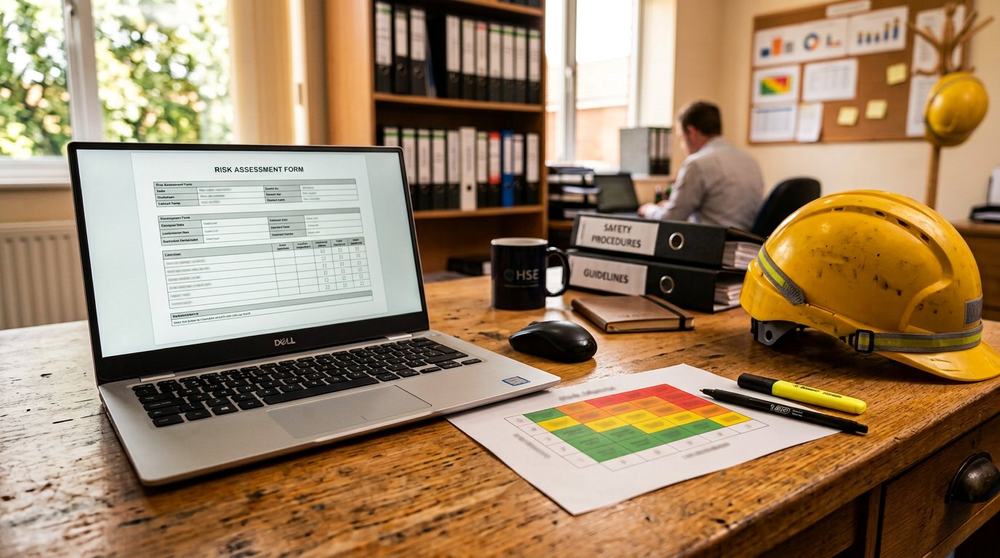
The planning tools are the ones that run before the task. The risk assessment matrix is the base — the 5x5, the likelihood, the consequence, the score, and the control. The matrix is the method, and the method is the own tool.
The JSA (the job safety analysis) is the task-based tool: the step (the break-the-task-into-the-steps), the hazard (the identify-the-hazard-per-step), and the control (the decide-the-control-per-step). The bowtie is the risk visual — the event in the middle, the threat on the left, the consequence on the right, and the barrier in between. The three are the planning, and the planning is the prevention.
The measure: the gas detector, the noise dosimeter
The measure tools are the ones that measure the exposure. The gas detector (the 4-gas) is the O2 (the 19.5–23.5%), the LEL (the 0–100%, the below 10%), the CO (the 0–30 ppm), and the H2S (the 0–10 ppm). The gas detector is the confined space — the entry is the controlled one.
The noise dosimeter is the 8-hour TWA and the dBA — the hearing loss is the avoided one. The lux meter is the light (the 500 lux, the office, the task), and the anemometer is the air (the wind, the spray, the direction). The four are the measure, and the measure is the data.
The control: the PTW, the LOTO, the PPE
The control tools are the ones that control the high-risk. The permit to work (the PTW) is the confined space, the hot work, the electrical, and the work at height. The PTW is the authorisation — the high-risk is the controlled one, and the controlled one is the accident avoided.
The LOTO (the lockout-tagout) is the energy isolation: the electrical, the mechanical, and the hydraulic — the lock, the tag, and the try-out. The LOTO is the maintenance safe, and the maintenance safe is the electrocution avoided. The PPE is the last line — the helmet, the eye, the hand, the foot, the respiratory, and the harness. The three are the control.
The record: the incident reporting, the KPI
The record tools are the ones that record the data. The incident reporting is the near-miss and the incident — the 5-Why, the root cause, and the corrective action. The incident reporting is the lesson, and the lesson is the system improved.
The KPI dashboard is the leading and the lagging: the leading (the training, the observation, the near-miss rate) and the lagging (the TRIR, the LTIFR, the fatality). The safety observation card is the worker report — the hazard, the near-miss, and the good practice. The three are the record, and the record is the improvement.
The online: the working tools and the calculator
The online tools are the working calculators. The HSE toolkit is the risk assessment matrix (the 5x5, the score), the noise exposure estimator (the 8-hour TWA, the 90 dBA), and the permit to work checklist (the confined space, the hot work). The toolkit is the free, the working, and the no-sign-up.
The resources are the templates: the risk assessment, the JSA, the PTW, and the COSHH. The templates are the fill-in-the-blank — the structure that the HSE fills with the site. The online tools are the 12 in the working form — the calculator that runs, and the template that fills.
Want the sign-off, not just the page?
The page is the preparation; the sign-off is the professional. For the statutory assessments, the ISO 45001 implementation and audits, the HSE CV and the training that comes with them, ask Muhammad Umer — 8+ years across Iraq, KSA and Pakistan, and the programme runs through umer-hse.pro. One message gets the written scope.
Common questions
HSE Tools — answered
What are the HSE tools?
The 12: the planning (the risk assessment matrix, the JSA, the bowtie), the measure (the gas detector, the noise dosimeter, the lux meter and the anemometer), the control (the permit to work, the LOTO, the PPE), and the record (the incident reporting, the KPI dashboard, the safety observation card). The online tools are the toolkit (the calculators) and the resources (the templates).
What is a JSA in HSE?
The job safety analysis: the task-based tool. The JSA is the step (the break-the-task-into-the-steps), the hazard (the identify-the-hazard-per-step), and the control (the decide-the-control-per-step). The JSA is the brief — and the crew knows the task, the hazard, and the control before the task starts.
What is the 4-gas detector in HSE?
The 4-gas detector is the confined-space entry: the O2 (the 19.5–23.5%), the LEL (the 0–100%, the below 10%), the CO (the 0–30 ppm), and the H2S (the 0–10 ppm). The 4-gas detector is the atmosphere tested — and the tested one is the entry controlled.
What is a permit to work in HSE?
The permit to work (the PTW) is the high-risk control: the confined space, the hot work, the electrical, and the work at height. The PTW is the authorisation — the authorised one, the verified one, and the closed one. The PTW is the high-risk controlled — and the controlled one is the accident avoided.
What is LOTO in HSE?
The lockout-tagout: the energy isolation. The LOTO is the electrical, the mechanical, and the hydraulic — the lock, the tag, and the try-out. The LOTO is the maintenance safe — and the maintenance safe is the electrocution avoided.
Where can I find the working HSE tools?
The toolkit is the calculators (the risk assessment matrix, the noise exposure estimator, the permit to work checklist), and the resources are the templates (the risk assessment, the JSA, the PTW, the COSHH). The two are the online tools — the working HSE tools, free and the no-sign-up.
Keep reading
Related career guides
What is HSE? Health, Safety and Environment, Explained
What is HSE? The full form (health, safety and environment), the three pillars explained, the HSE role in the
Community · 7 September 2026HSE Topics: the 20 Topics That Make the HSE
The HSE topics, listed and explained: the risk assessment, the fire, the chemical, the lifting, the electrical
Community · 9 September 2026Environmental Safety: What It Is, and the Difference
Environmental safety explained: what it is, the difference from occupational safety, the integration of the tw
THE HEALTH AND SAFETY is an education and knowledge network. The community pages are free and open; the professional assessments, the CV work, and the training run through umer-hse.pro.
Disclaimer
The salary ranges on this page are the typical market ranges for guidance, not a guarantee — the number moves with the experience, the qualification, the industry, and the location. The role descriptions are the practical baseline built to the UK standard with the US equivalents named; where a duty has legal force, the employer and the responsible person own it. Read the page as the preparation for the application, the interview, and the first day on the site.